
Chapter Twenty-Three
(a description of the Trail Days festival)
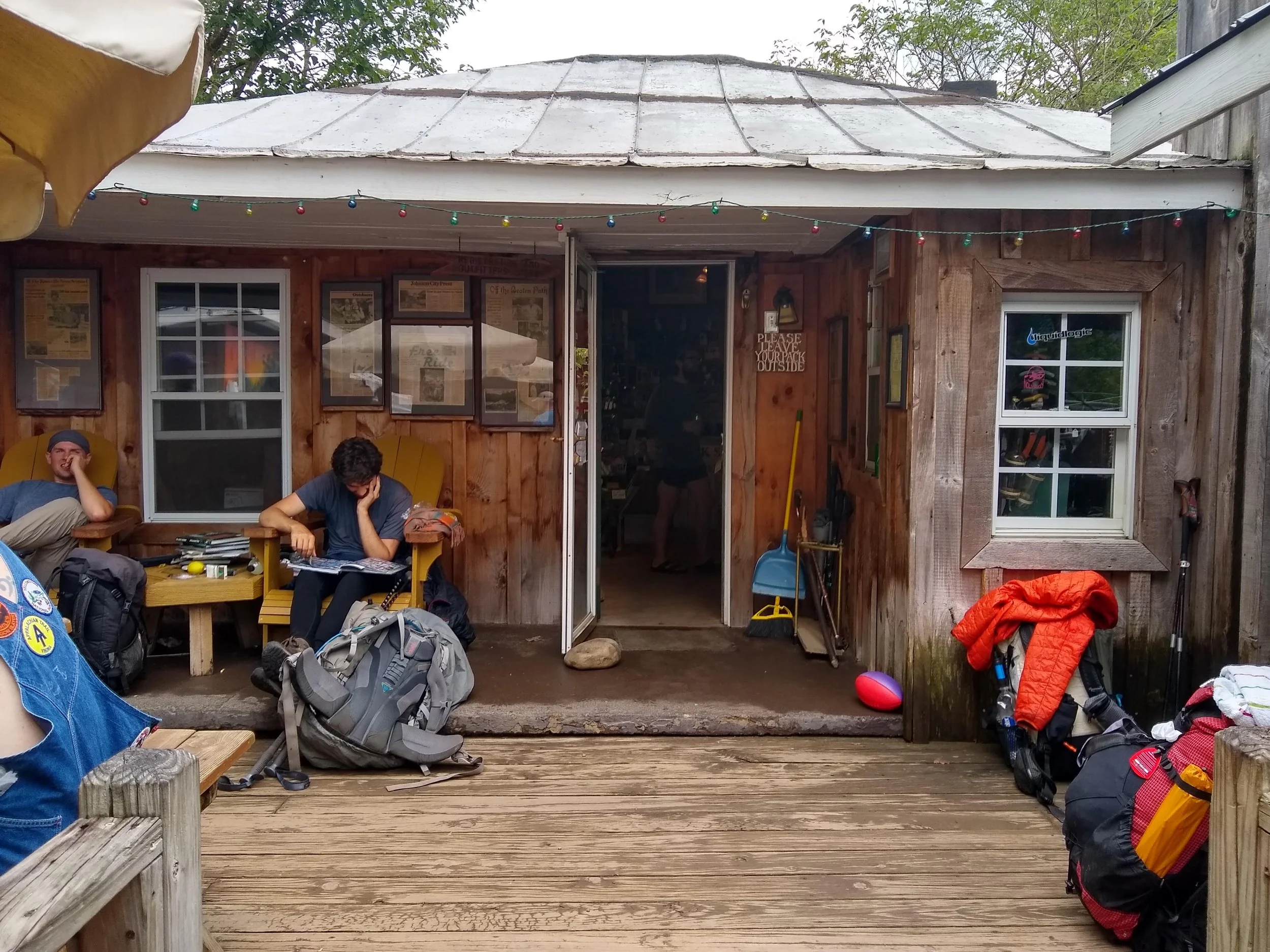
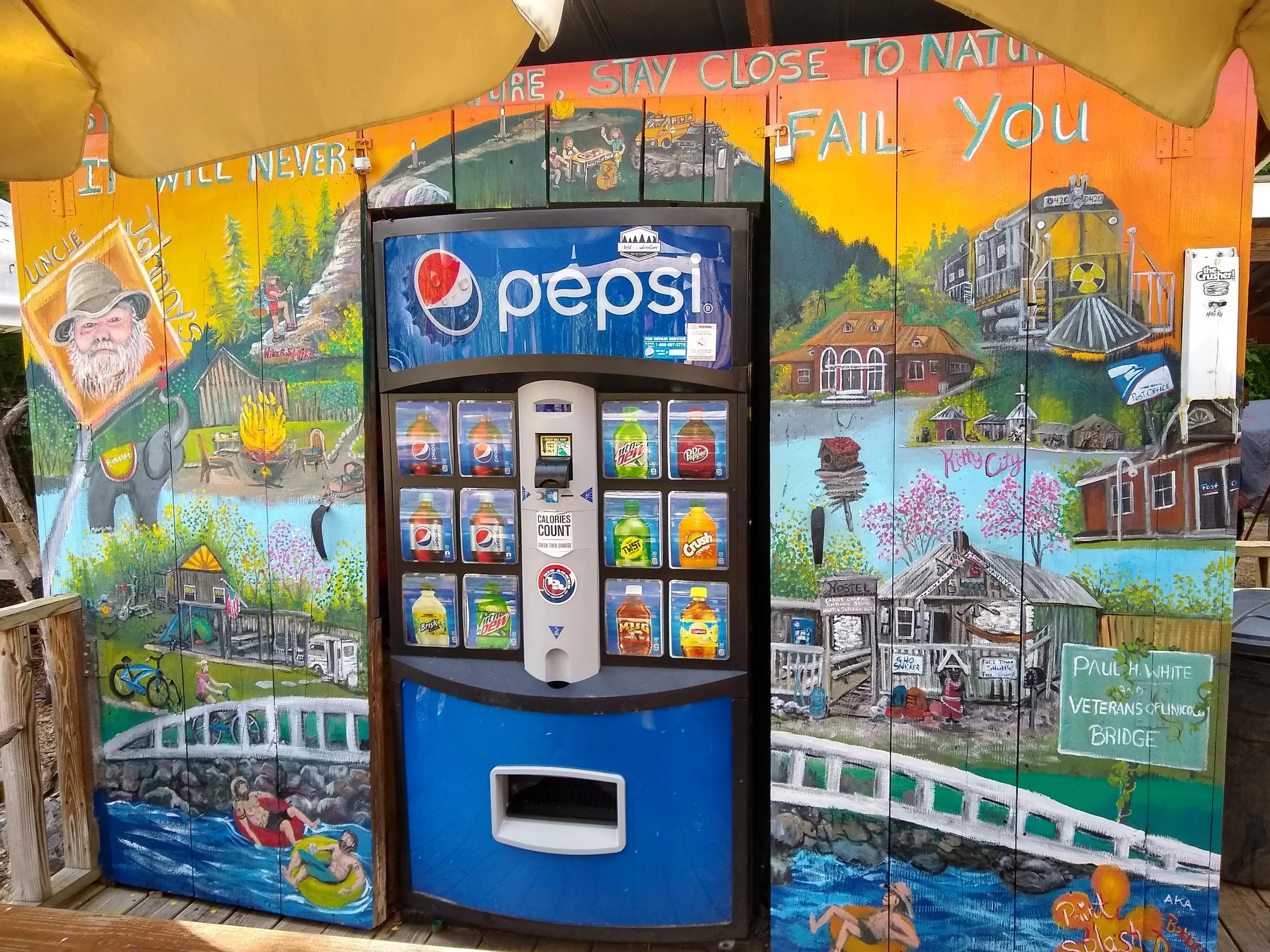
Uncle Johnny’s Nolichucky Hostel is another hiker institution that is literally steps from the AT. It is a small, ramshackle wooden building with a rusted metal roof at an intersection of backroads in Erwin, Tennessee.
When I walk up to the hostel there are about a dozen hikers sitting on the porch drinking morning beer and eating tortilla chips. They raise their beers to me in a fuzzy toast as I drop my pack.
I am meeting my father here and we are going together to Trail Days.
Trail Days is an annual weekend festival held in Damascus Virginia celebrating the trail and the year’s batch of people attempting to hike it. Former thru-hikers attend it as a reunion. There are special activities, zany traditions, vendors selling equipment, food and drinks, and most importantly, a parade through town. It is the only chance for the entire hiking community, which is usually spread out over two thousand miles, to come together in a single place.
The logistics of getting to Trail Days can be irksome. Most north-bound hikers who start around April 1st will be somewhere in the vicinity of Damascus, give or take a couple hundred miles. This means they will have to find a ride to Damascus, and then back to where they were on the trail. Most hostels offer shuttle rides, for a fee, and many entrepreneurial van owners become long-distance taxi drivers. There are a few trail angels who offer rides for free, and if you are close enough you can try hitch-hiking.
When Dad arrives I toss my pack in his car and we shake hands. I am happy to see him. The beard he had started growing is gone.
It is a little over an hour of highway driving to Damascus from Erwin. The speed of car travel makes me giddy after walking for so long. It is good to be with Dad again. “Turns out,” he says, “the pain in my foot was a cracked Planner Plate. Got to have surgery. So, pretty serious.”
“Wimp,” I tease.
Damascus is a small town at the very bottom of Virginia, just north of the state line. Normally its population is around eight hundred, but for one weekend every May it swells to nearly twenty thousand as hikers, vendors, sight-seers, and anyone with any kind of connection to or interest in hiking convene for the annual celebration of Trail Days. Bigger than Hot Springs, but smaller than Franklin, Damascus is a working class town with small neighborhoods of modest, well-maintained houses. The yards are neatly mowed and American flags are everywhere.
The Appalachian Trail goes directly through the town park, passing playgrounds and gazebos. There is an impressive veteran’s memorial and a large modern-looking library nearby. This area is where the equipment vendors, concession stands, and outdoor stage are all set up.
Dad is staying in a hotel but I choose to stay in Tent City. Tent City is where all of the thru-hikers in town for Trail Days pitch their tents, near the outskirts of town. Here there are a couple of baseball fields and a church across the road. Past the baseball diamonds is a small grassy area covered in tents, and a wall of trees where the town ends and the forest begins.
It costs ten dollars to camp, and I get a bracelet that will let me come and go from the tents as I please. I choose a spot facing out over the baseball fields.
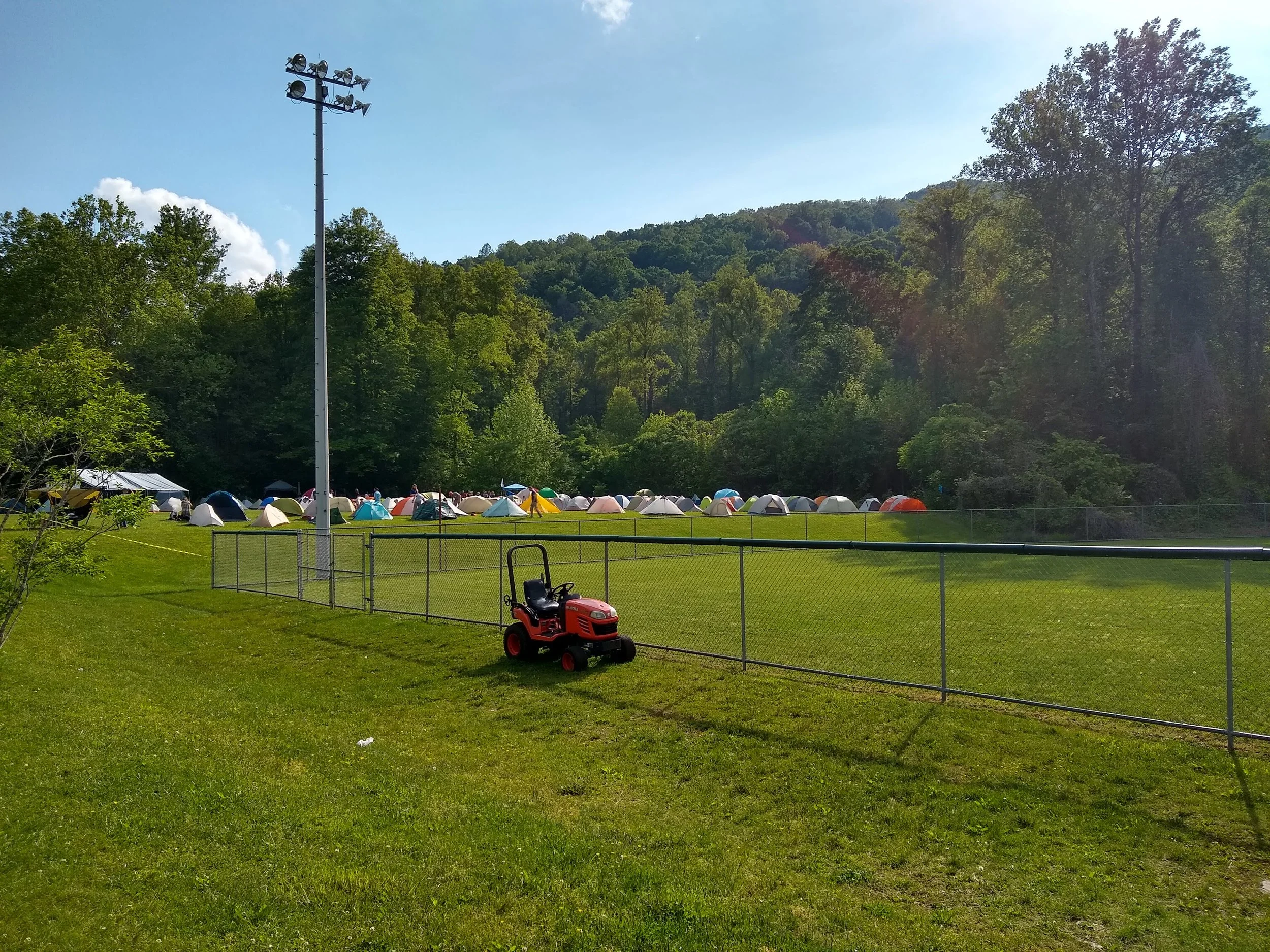
This initial grassy area by the baseball fields is only a small fraction of tent city, known as ‘the quiet zone’, like the visible tip of the iceberg. The unruly bulk of Tent City is within the forest that grows beyond it. Trail legends abound concerning the boisterous and disorderly activities that go on in the ‘Dark City’, and it is understood that anyone who desires a restful night is advised to camp in the quiet zone.
I lay in my tent as darkness falls outside, writing notes by headlamp. Soon I get a text from Lonebear.
Hey, where you at? Wanna hang out? I got some beers
Soon we are standing together in the grass at the edge of the field, our headlamps turned to the redlamp setting. We both hold giant cans of warm Miller Lite.
“How’d you get here?” I ask her.
“My dad drove me. He got stuck bringing up a whole load of hikers. He says his truck will never smell the same. Sky Man is right over there, he’s one of the hikers that rode up with me and my Dad.”
Walking toward us is a thin man in short-shorts and a black tank-top. He is bald and wears glasses. He has a bushy gray beard and the wiry physique of a gymnast, all bone and muscle. We talk to him for a while. He is gregarious and laid-back, rippled by spasmodic energy and full of interesting hiking stories. Then he goes into the forest.
“He’s a trail bum.” Lonebear tells me once he is gone.
“What?”
“A trail bum. He lives on the trail. He’s thru-hiked like ten times. He works in a restaurant during the winter to save up money, then just hikes the trail every year, living super cheap.”
“Interesting.”
We go back to our tents and agree to meet the next night.
#
#
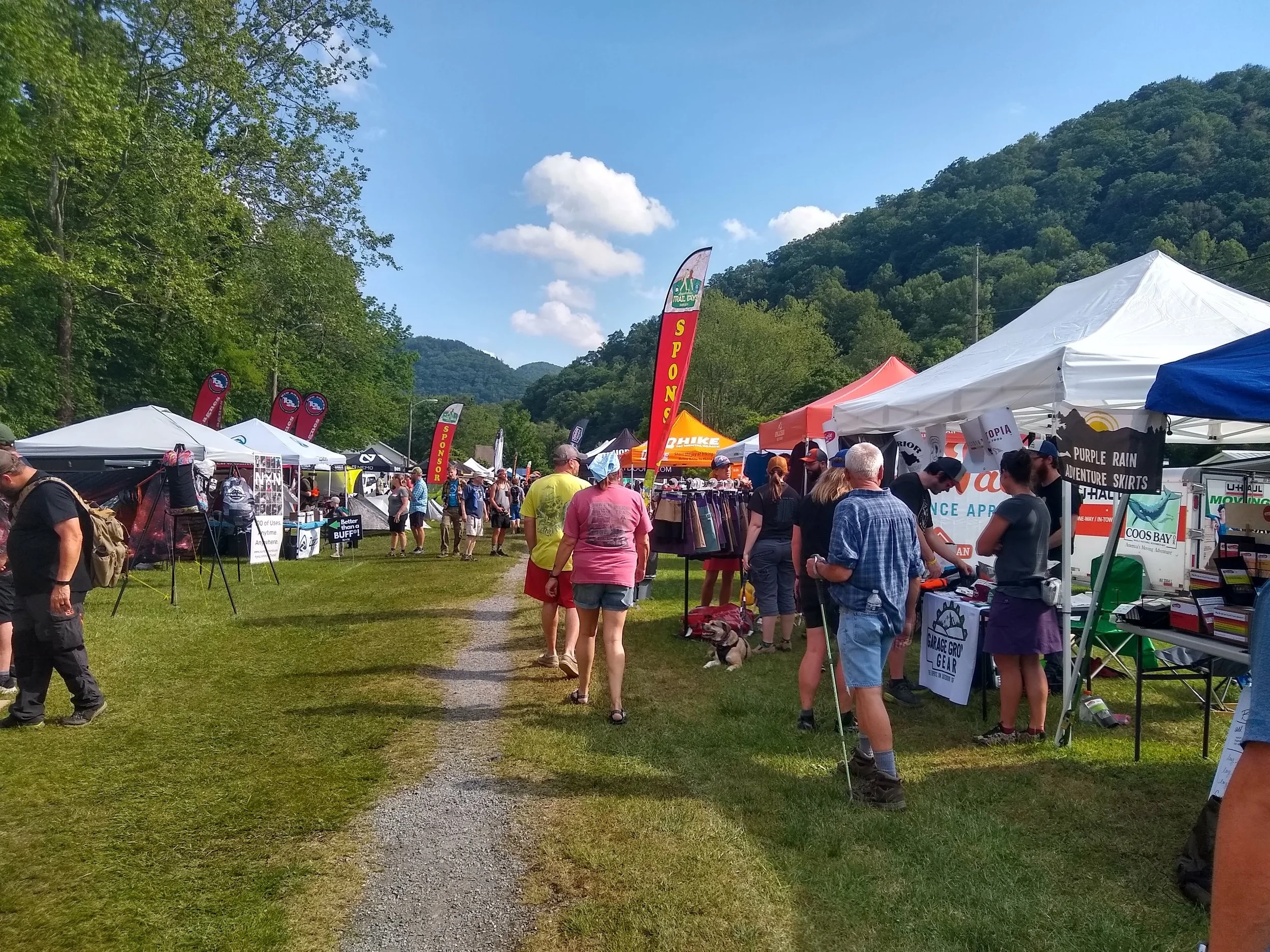
The town is in full Trail Days swing. Vendors are out in force and crowds are everywhere. Normally thru-hikers are easy to spot in a crowd due to a combination of clothing, facial hair, and general raggedness. Here there is a layering of appearances. Many people wear recently purchased hiking clothes or carry recently purchased backpacks over their shoulders. Former thru-hikers who have come to celebrate wear their old hiking get-ups for nostalgia. Day hikers wear shorts and carry lightweight packs. It’s difficult to tell just by looking who is actually thru-hiking and who isn’t.
What does stand out are the dozens of men in dresses moving down the aisles, decked out in gaudy plastic jewelry.[1] Dad, who is unaware of the cross-dressing tradition, is puzzled. “What the hell is going on?” He asks as we walk, “I mean, I knew there were a lot of Liberals on the trail, but this is a little much.”
I try to convince him that it is only part of the radical self-exploration inherent to the thru-hiking experience, yet he remains ill-at-ease.
The booths bristle with new and colorful things. Clothing, shoes, cookware, equipment. It seems the manufacturers of anything related to hiking are in attendance. Aluminum sporks, sweat-wicking fabrics, doggie-sized sleeping bags. We walk down endless rows of products until it begins to feel like walking past booths at a carnival.
To be amid so much cool and varied equipment is both captivating and repulsive. The baser parts of me want to inspect every gadget, to lay in every hammock, to feel with my own hands the near-weightlessness of every article of dyneema fabric. The sub-ounce weight of a titanium sprondonical makes the gear-head within me salivate.
Yet a deeper part of me knows that this is not true to the trail and that all of this is only a materialistic distraction. It is a manifestation of a growing fixation with purchasable items that has in some way come to eclipse the real hiking experience. It seems like people spend more time in REI than they do hiking or camping, or they sit inside reading gear reviews endlessly online. The accumulation of possessions has become the incentive to hike, rather than the shedding of them. This seems to me antithetical to the goal / method of thru-hiking, which is to separate yourself from all but the most basic and necessary of things required for survival. To step away from the world of commercial obsession and manic consumption. To wrench your psyche free from the grip of industrial propoganda and escape the commercial fallacy, the belief embedded in our minds as small children by corporate advertisements that the purchase of something will bring us closer to being the person we want to be, or experiencing the things we want to experience. The fallacy that traps people in an endless loop of trying to build a life they see on television or Instagram, one purchase at a time. Like buying pieces to a puzzle where is writ the true meaning of life, only you always need just one more piece to make the message whole, one more car, one more cell phone, one more college degree. One more pair of Merino Wool hiking socks. Thru-hiking is an escape hatch from that way of life, or at least it’s supposed to be, and I imagine that the booths at Trail Days create more than a little cognitive dissonance for many hikers.
#
Soon it is time for the parade. The crowds of hikers all begin to move down sidewalks and streets, flowing in the same direction. Dad and I move along with them as if carried by a current.
The hikers convene in the Subway parking lot at the outskirts of town, a loud and unruly crowd of sunburned people in hiking clothes and men in dresses. People hold beer cans and squirt guns. The street is blocked off by police cars.
The parade is separated by year-groups with the thru-hikers of the earliest years marching first and those from more recent years following after. The current year is at the end, and is always the largest and most excited of the groups. Handmade signs read 1994, 1983, 2003. Dad and I stand together under the sign that says 2019.
Soon the crowd spills out into the road and begins to march, pulling us along with it. We pass the outskirts of town and start walking by businesses and homes. The people of Damascus line the street on both sides, cheering as hikers go by and dousing them with water. Most hold squirt guns and fire madly at everyone, some toss buckets of water into the crowd. A couple houses have garden hoses running from spigots to the road and are spraying into the air so that droplets fall down on the heads of the hikers like rain.
We move down the road in a loose, happy mob, passing little yards and old brick buildings and rusty pickup trucks, surrounded by all the elegant decay of a small Appalachian town in the first flush of summer. Above us the sky is very blue and the green mountains that surround the town rise against it in the distance. Townspeople are all around us, screaming and squirting. Jets of water shoot through the air like tossed spears and everywhere is the sound of splashes and screams. I am pelted with cold water and am soon drenched, my feet soaked from stepping through puddles.
A key part of the parade tradition is this soaking down of the hikers by the people of Damascus, this mass dousing. It is styled as a 'bath', in reference to the malodorous reputation of thru-hikers coming in from the trail. The hikers love it. In the heat the water is refreshing, and it all has the feeling of small-town, summertime fun.
Momentary strips of rainbow form in the mist-like bursts of water in the air above us, ephemeral streaks of color appearing and disappearing in clouds of vapor. The air is filled with Petrichor, that stray dog's perfume.
The parade moves down the little streets in a chaotic frenzy of bearded men in dresses and kids in tie-dye and girls in bikini tops. People stand in the beds of trucks parked along the street and fling five-gallon buckets out into the crowd. Grandmothers and grandchildren stand together and unload massive squirt guns with gangster-like wraith. We move through a broken rainstorm.
Beneath these playground shenanigans lies a deeper meaning, a significance we all feel but never speak, as if any attempt to articulate it would damage the irreverent illusion that allows it to exist at all.
The parade, at its essence, is a bathing ritual. A group cleansing. We come in from the wilderness dirty and smelly and hungry and poor, in half a hundred small American towns. The smells of our body, the thinness of our budgets, and the senselessness of our endeavor are all affronts to the core American values of cleanliness, capitalism, and good common sense, concepts held in especially high regard by these small rural communities. Tolerated but not understood, there is always the feeling of being on the outside, not just of the particular town or restaurant or hotel we happen to be sitting in, but outside the underlying systems these places are built on. We are outside the mechanism. We embody the counter-values of motion, minimalism, and the questioning of all things. We are transients passing through, wandering in from the wilderness past the edge of town and wandering out into it again. We do not belong.
Damascus, king of all trail towns, offers us absolution and cleanses us of our transgressions. The world of jobs, mortgages, respectability and community gathers to applaud our willingness to go beyond it, and in that applause there is a sense of being born again. The parade is a way to subconsciously drag those feelings of exclusion into the open and cleanse them. The hoses used on well-kept lawns and expensive cars are turned for a day on us, and the water washes places that no rain could reach. We begin the parade as pariahs, and end it as citizens of Damascus, which makes us citizens of every trail town.
It is also a way for the town people to purge their understandable frustrations with having to interact with foul-smelling hikers anytime they are out and about at a grocery store or restaurant, a burden I'm sure gets old. All these things mingle and merge into a sprawling ceremony of celebration and acceptance wherein the world we all rejected forgives us and takes us back.
"Take your bath you stinky hikers!" Screams a small boy with glee as he sprays a squirt gun madly into the crowd, "Take your bath!"
The hikers throw their arms out and their faces back and laugh and scream. We all want to be sprayed. Men yank blouses up to reveal hairy chests in gestures of mock exposure and are promptly blasted with super soakers. Girls shriek joyously when splashed by buckets of ice water. A woman runs out into the road and empties a bottle of water directly onto my head.
The parade is a way to receive salvation, to wash away miles and tears and memories of the selves we had left or lost somewhere before the going. At the end we all feel saved.
#
Back at Tent City I sit in my tent and stare out at the baseball fields. The kudzu-draped trees make a dark wall in the night. A high and wild barrier separating the town from the forest, the old from the new, the light from the darkness. The known from the unknown. On one side are baseball fields and a church, the clean geometry of civilized recreation and organized religion. On the other side is wilderness and fire and drums sounding from deep within the trees, a rhythmic beat calling to the animal in man. It was a living threshold to the world of ancient things.
Lonebear texts me. She has beer and wants to hang out. I meet up with her and a tall German girl named Breeze that Lonebear is friends with. We all go together into the forest.
Everywhere among the trees are the vague shapes of tents stretching away as far as I can see. We move along the path by feel more than sight, down the dark maze of pathways, following the gigantic heartbeat of the drum circle.
We reach the clearing filled with drums and firelight and flailing bodies. For a while we only stand at the edge and watch the wild, thumping chaos. There is a sea of people churning around the drums, faces painted and bodies shaking. Glowing plastic bracelets make neon smears of light. Fire-dancers stand past the edges of the crowd and fling flaming batons into the air. The world bombinates with sound.
A short and stocky old guy wearing only a beard and a kilt comes jigging up to us. “Come on in,” he says, “the water’s fine!” Then jigs back into the crowd.
We are drawn into the mass of people and motion and rhythm, like swimmers at the edge of a whirlpool. We sway with the sea of bodies, tipsy with cheap beer and jungle-drunk on sound.
A flower-child girl comes around and offers us strange wine. Lonebear and I both drink from it. My memories get blurry after that, and the night becomes a series of smeared images all super-imposed onto one another, dark and glowing scenes aligned haphazardly and diachronically in my mind.
I remember being in a long line of people worming around the field in a crazy conga line, everyone chanting, “Let’s get nay-kid! Let’s-get-nay-kid!” I remember a guy pounding on the drums collapsing, just going limp while drumming and falling to the ground, either from exhaustion or too much drink. The drums stop. Some people drag him to the side and prop him up against a tree. The drums begin again.
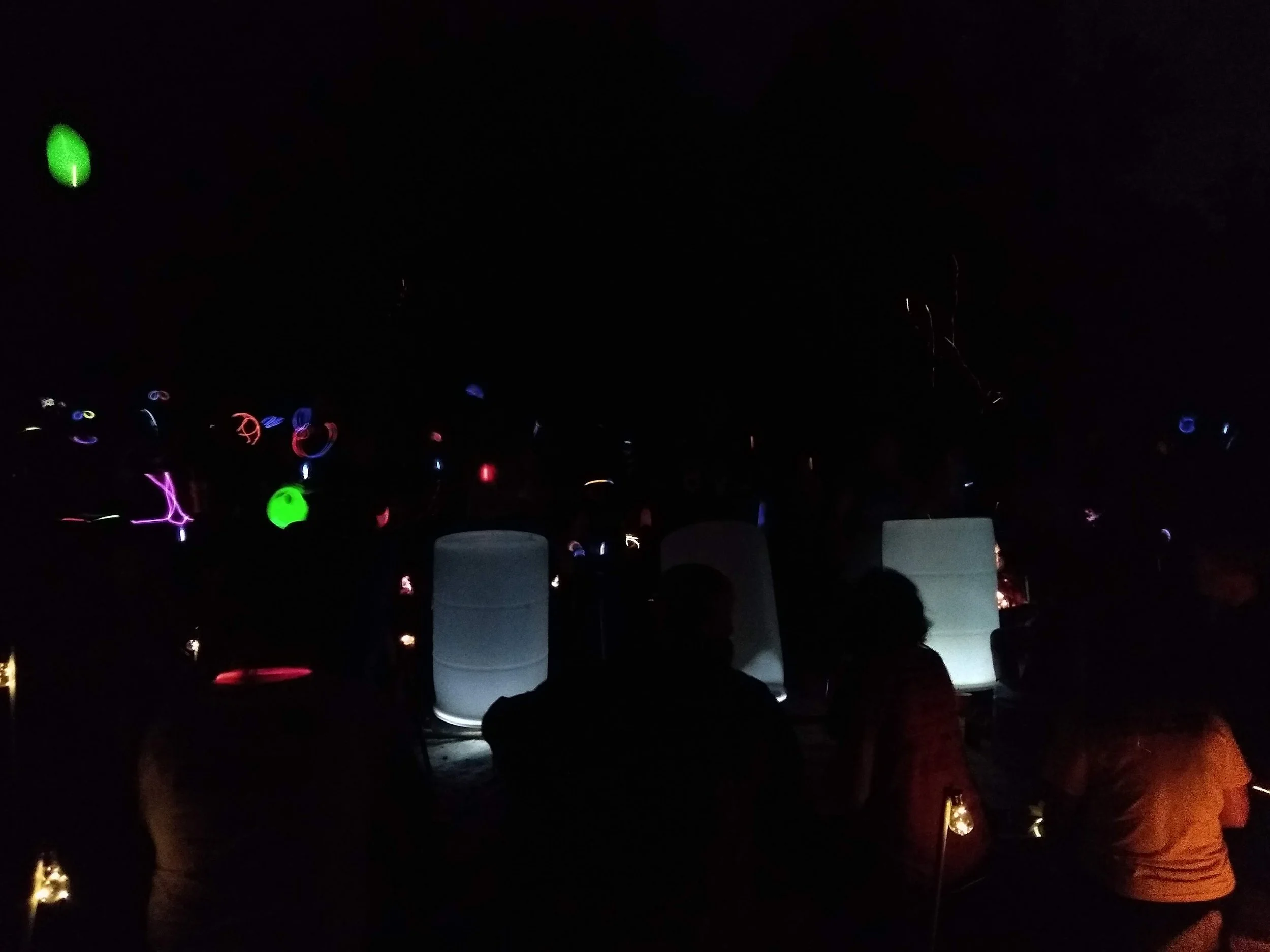
At one point I am standing next to Lonebear in the drum circle. Before me is the bottom of an upturned plastic barrel. Lonebear and I both hold the same bamboo stick, pounding the same drum.
The drums beat in time, and the heavy thumping meshes together in a rough harmony. The sound is everywhere, is everything. A simple rhythm that somehow contains the world within it. We get lost in the sound. It grows from the drums and spirals upward and outward, enveloping the crowd of people and rising toward the stars. The beating of each individual drummer instinctively conforms to the group beat, and the sound becomes something all its own, a separate force that consists of all of us but belongs to none. We are held by it, enthralled to it. Lone Bear's face is a mask of concentration beside me at the drum, pale and intense and beautiful.
From the circle, that most ancient and yonic of all shapes, something ageless is reborn. A primal echo reaching all the way back through history to the time before man had ceased his endless wanderings and the world was one great forest. It was the first song, the oldest drug. Wild faces hover above the other drums in the same trance-like ecstasy of rapture, half-hypnotized by sound. Glow sticks and fire make a witch-light burning in the darkness. We might have been ten thousand years in the past.
We are possessed by the drums. The drums are in us, using us. We are part of the sound, and through it part of each other, part of the circle. Part of the group, the tribe, the moment, the world. We are all enfolded into an invisible mind-link, and for a short, thoughtless period exist as part of something deeper than ourselves. For a brief time we are, all of us, lost together.
I don't know how long we drummed, maybe half an hour, maybe four. Lonebear and I beat the drum until the bamboo stick splits apart in our hands. Then we step away.
We find Breeze and stumble back through the forest. Hungry, we decide to stop at the camp of the Yellow Deli. I have ominous feelings about the Yellow Deli, but in my current state I can’t remember why.
In a little hollow in the woods lit by pale, buttery light there is a table with a giant pot on it. A serene old man scoops heaps of spaghetti into paper bowls for a line of hungry, half-drunk hikers, free of charge. We sit on a log to eat and are immediately approached by an incredibly cheerful, incredibly drunk old man from Tennessee.
The old man is asking every hiker what state they are from and why it is the best state. That the hiker is automatically supposed to view their state as the best state and defend it is something he takes for granted, a trait I find oddly endearing. Lone Bear, who is unskilled in conversing with drunk old southern men, simply says Massachusetts. Breeze pretends she is from Minnesota, but the guy is too drunk to catch on to her obviously German accent. I say Georgia.
"Nother southerner!" The old man proclaims, "Yur already ‘head of the rest. And why, pray tell, is Georgia the best state?"
"Because the peaches are beautiful and the women taste delicious."
The old man roars with delight and the women cry misogyny. I feel triumphant.
The old man claps me on the shoulder with genuine respect and affection, "You're alright Georgia, you're alright." He shuffles off and we keep eating our spaghetti.
"They're a cult, you know." says another drunken hiker sitting close to us. He is a hirsute man in a powder blue dress sitting with knees akimbo. Thankfully there are shorts beneath.
"Who?" Breeze asks him.
The hiker leans in toward us and speaks in a low hush. "The Twelve Tribes." He nods toward the table of spaghetti and the old man. "Full on cult. They come to trail stuff just to ensnare people. They get the weak ones and take them back to their farm and brainwash them."
"No way." Breeze says.
"Yeah!" the hiker urges, "They got a hostel somewhere up north. Every year a few thru-hikers check in, but they don't check out. They go to the farm." The hiker raises his eyebrows in seriousness, and in the pale light looks grim. One of his dress straps falls from a hairy shoulder and he tugs it back up reflexively.
I remember now why I had felt ominous about the Yellow Deli. I had heard these stories before about the Twelve Tribes, that they ran restaurants and hostels to lure in new cult members. Once they had you they took all of your money and made you live on a farm. I had thought them only more ghost stories of the trail, like mountain lions in the Shenandoahs, or the mud pits in the White Mountains deeper than a man. All communities need ghost stories to darken the depths of their mythologies. Here in the queer yellowish light though, I am not so sure.
The dress-wearing hiker leans in closer. "We're eating cult-spaghetti right now!"
Back at the tents we say goodnight to Breeze and I stand a while with Lonebear. It is dark and we are alone. Her face is only an outline, a gentle sketch in the darkness. I want to kiss her but I am worried that she/I is/are too drunk for that to be appropriate. I tell her she can ride with Dad and I back to the trail the next day. Then I collapse alone in my tent.
#
The morning is wet with dew and dampened by a sense of ending. A hung-over disorientation combines with a mad scramble of hikers trying to find a ride to wherever they got off the trail. Packs are packed with sloppy haste, and an endless line of cars and buses circle through the baseball field parking lots, filling with hikers and then taking off.
I get a cup of coffee from the free church breakfast and walk around the park. The vendors are tearing down their booths, and all the hikers who camped in the churchyards and town hostels are packing their tents. Banners are coming down and the sidewalks are being swept. Trail days is over, and Damascus is left with only feelings of faded festivities.
As I sip my coffee I contemplate the last couple days. Trail Days, like anything associated with thru-hiking, is shambolic and strange. A clash of commerce and tradition, of debaucherous celebration and perplexing ceremony.[2]
Now that it’s over I try to figure out what the point of it was.
Trail Days is like a music festival without the music, or a game day celebration without the game. The object of celebration isn’t tangibly present or easy to identify.
If you were to ask anyone here what was being celebrated, they would invariably tell you, ‘The Trail.’ What does that mean, though?
Do they mean the physical trail itself, the actual two-thousand plus miles of ground? Is it the people attempting to thru-hike it in a given year? The legacy of those who have hiked it in years past? Is it the abstract formulation of the trail in the mind as a concept, the idea of the trail? Is it the legions of volunteers who maintain it? Is it the unquantifiable sense of adventure and departure from the norm that the trail for so many represents? Is it all these things? None?
No one else seems overly concerned about the vagueness, and after a while I stop trying to figure it out. Ultimately, I conclude that the point of Trail Days is as formless and variable as the trail itself, which is to say that you are left on your own to figure out what matters and why.
Buried somewhere in the strangeness of it all is a feeling of connectedness, of coming together. Of hikers from this year uniting with hikers of generations past to lock arms and march down the streets of small town America, baptized by cheering crowds. A freak-show on Main Street.
[1]. It is an inexplicable aspect of Trail Days tradition that some male thru-hikers dress in drag for the parade. This is usually done with cheap, thrift-store clothing and costume jewelery, and with varying degrees seriousness. Some guys just throw a dress over their hiking shorts for the duration of the parade and then take it off. Others apply makeup and eye-liner and paint their nails and wear flower-pattern sundresses for the entire two or three days. I see more than one guy in high-heels and an actual blond wig. There are even some fake, melon-sized breasts. It is not uncommon to see entire groups of men in drag moving past the vendor’s booths or laying in the grass in the park. None of the hikers I ask seem to know how or why the tradition originated, or why it is continued. The general attitude is that it is something fun to do while drunk.
[2]. The group bathing ritual I feel I understand, but what about the cross-dressing? What do men in dresses have to do with thru-hiking? Is it a way to convey the absolute freedom of trail-life and the hard separation from societal norms and expectations which trail-life provides? Is it an all-out rejection of assigned behavioral roles in favor of an odd but individual selfhood? If so, why is there no analogous tradition for female thru-hikers? Is it symptomatic of a latent homosexual undercurrent that likely exists whenever groups of men separate themselves from their wives for prolonged periods, i.e. sailors, soldiers, etc? Does it mean anything at all, and if not, then why do it? When and why did it become part of the Trail Days tradition? It is too convoluted an issue for an amateur anthropologist like myself, so I leave the puzzle to better minds and simply enjoy the madness.